

Budget
Soliman faces the council
The director of the Mayor’s Office of Management and Budget insisted he dislikes the idea of raising property taxes during an hourslong grilling before the City Council Finance Committee.
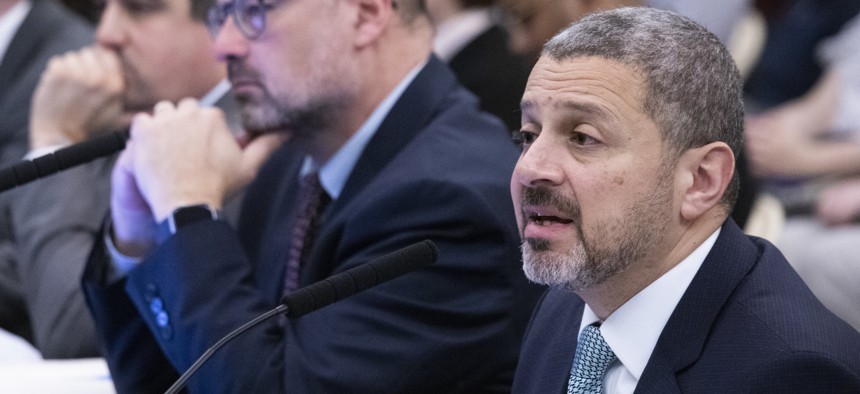
Budget Director Sherif Soliman testified before the City Council Finance Committee on Wednesday March 25. John McCarten/NYC Council Media Unit



The Department of Sanitation will vacate underused office space. The Fire Department negotiated lower pricing with telecommunications providers. The Taxi and Limousine Commission will cancel its Slack subscription.
These are a few of the ways the Mamdani administration proposes to find $1.7 billion in savings in the city budget, the mayor announced Wednesday. The initial list of proposals City Hall released adds up to just $245 million – a mere drop in the bucket compared to the budget deficit. The Mayor’s Office of Management and Budget is currently reviewing the other proposed savings measures suggested by newly appointed “chief savings officers” across city agencies.
“The submissions by the agencies were over $1.7 billion. We are doing the painstaking work of going through their submissions, having a dialogue back and forth,” OMB Director Sherif Soliman told City Council members at a marathon preliminary budget hearing Wednesday. “What was announced today were concrete examples, highlights of a couple of hundred million dollars, and that process continues.” After Soliman didn’t attend the Finance Committee's first hearing earlier this month while fasting for Ramadan, it was council members’ first opportunity to press him for answers.
The $5.4 billion projected budget deficit hung heavy over proceedings. As the mayor’s $127 billion preliminary budget proposal already assumed $1.77 billion in savings, Wednesday’s announcement did nothing to reduce that gap. While Soliman was optimistic that the state would help close the deficit – either by raising taxes on the wealthy or by allocating additional funding – he acknowledged that the city was still considering other options: pulling from the city’s reserves and raising property taxes for New Yorkers. Both prospects are highly unpopular with council members.
“The story of this budget leaves us with some fundamental questions that must be answered,” City Council Speaker Julie Menin said Wednesday. “We strongly believe there is no reason to draw down excessive reserves.”
Menin also reiterated that increasing property taxes is a nonstarter with the council. Soliman argued that while the Mamdani administration does not want to raise property taxes or draw from reserves, the city may not have a choice – not without aid from the state and the partnership of the City Council.
“We do not want to raise property taxes, we want property tax reform, and that is what we are busy working on. We don’t want to draw down reserves, rather we want to replenish reserves and we want to grow reserves. This was out of necessity for what was an inherited significant budget challenge that stemmed from chronic underbudgeting,” he said. “We would like to avoid that and that is why we want to work alongside you.” (The New York Times reported Wednesday that the mayor is quietly backing away from the property tax hike idea.)
While Soliman acknowledged the city would work to identify further savings beyond the $1.7 billion in the months ahead, he said that it’ll be challenging to do so without cutting services. According to the Mamdani administration, the initial $245 million in approved savings fell into five different categories: public service efficiencies, contracting efficiencies, modernizing technology, downsizing and lease management, and “financial adjustments and new revenue.”
Andrew Rein, Citizens Budget Commission president, said that while the mayor deserves credit for beginning to look for savings, the list released Wednesday is just a start.
“The administration will have to go much further than the $1.7 billion target – and there’s plenty of opportunity,” Rein said in a statement. “This administration must be as ambitious about government efficiency as it is about affordability. That means real transformation on how we run government, and not spending money that doesn’t help New Yorkers.”