

Criminal Justice
Robert Brooks’ father pushes for new office to probe prison deaths as counties push back
County coroners are fighting to retain jurisdiction over prison fatalities.
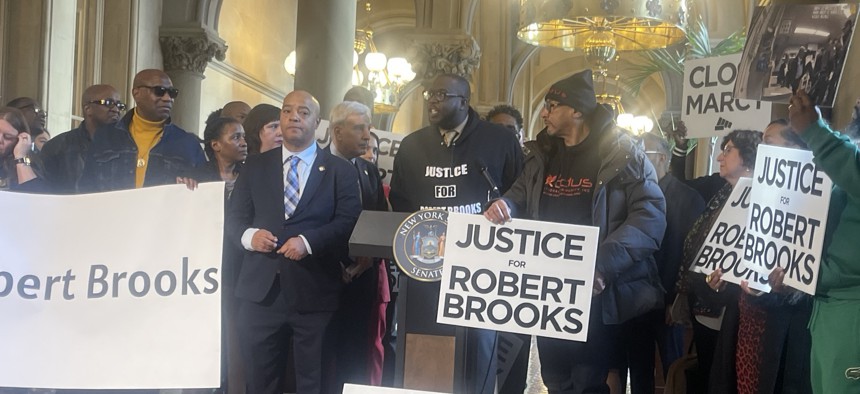
Assembly Member Erik Dilan and activists rally for prison reform on Jan. 27, 2025. Kate Lisa


The father of Robert Brooks, the incarcerated man beaten to death by former officers convicted of murder, is joining a push for funding in the budget to create a new state entity that would perform independent autopsies of people behind bars. But counties are fighting the proposal.
The Assembly included a proposal in its one-house budget to give the state Commission of Correction jurisdiction when an incarcerated person dies in the state – removing that power from local county coroners and medical examiners. It earmarks $3.7 million to create a new Office of the Chief Medical Examiner within the commission, which would be independent of the state Department of Corrections & Community Supervision. And advocates are pushing for its inclusion in the budget as negotiations drag on now 10 days past the deadline.
Brooks’ father, Robert Ricks, said the office is needed to maintain transparency and accountability within state facilities, and that his son’s 2024 killing by corrections officers at Marcy Correctional Facility, which was captured on officers’ body camera footage, shows prison guards have beaten people to death in the past without an independent investigation or accurate record of what took place.
“It’s absolutely necessary considering all the things that have come to light at this point,” Ricks told City & State in an interview. “It's not up for discussion – we know that it happens, and we know that people will disregard it. We know that people will lie about it and they will hide the truth … It would be a different story if it was an isolated incident. But it’s not.”
Eric Schneiderman, the former state attorney general, has represented Ricks for over a year and lobbies for prison reform in Albany. He said an independent examiner is necessary to gather evidence because county coroners are not doctors, and can be subject to influence by prison officials.
“County coroners are really a relic of the past,” Schneiderman said. “We just don't trust that the county coroners have the skills, or have the interest, in really doing a thorough evidence collection (in prison deaths). So this would change that, which is tremendously important to seeing the justice to be done.”
But many leaders in many of the state’s 62 counties are against the proposal. Stephen Acquario, executive director of the state Association of Counties, said the pain of Brooks’ murder and the failures that led to his death cannot be ignored, but the creation of the office would unnecessarily spend millions to duplicate what already exists at the local level. And he believes the new entity – which would require toxicologists, DNA experts, specific vehicles to transport bodies and other equipment – would cost well over the Assembly’s estimated $4 million.
“It's duplicating a service already in place, already functioning, already capable of providing independent forensic legal investigation that needs to be had,” Acquario said Friday. “It speaks nothing to how people are transported, relying on local police entities who are not trained in this type of moving bodies … So there's just no guarantee of a better investigation, no guarantee (of) better accountability.”
Acquario also pointed to likely issues the state will encounter to hire three medical examiners for the office. The U.S. has a national shortage of forensic pathologists, and recruiting even one is extremely difficult in the state.
Rather than creating a new office that would tear away county coroners’ jurisdiction over prison deaths, NYSAC instead wants county coroners to receive updated training. Acquario said county examiners are a fixture of local history and their authority shouldn’t be tampered with, particularly since prison deaths are rare and do not take place in every county each year.
“These are ancient historical positions of the crown,” Acquario said. “The coroner and the medical examiner go back to before the state was even in existence. It’s well-intentioned, certainly, by state lawmakers … but I think it can be best done through training.”
But Ricks said the creation of the independent office shouldn’t be a question.
“We know that the system is corrupt, we know these things today,” he said. “So, what's the problem? Why would you not want to implement something that is going to prevent, or at least make people give pause, when they start putting their hands on other people's fathers, daughters, sons and mothers?”
Neither the state Senate nor Gov. Kathy Hochul included the office in their budget proposals. As state leaders plod through significant policy items like car insurance reform, climate rollbacks and more, it’s unclear if or when the Office of Chief Medical Examiner will come up in conversations.
The number of undetermined deaths in DOCCS facilities make up a low percentage of deaths in DOCCS custody, according to Hochul’s office.
"Gov. Hochul has been clear that the safety of all staff and incarcerated individuals is a priority, and her administration remains committed to implementing fundamental, systemwide changes to ensure the state's correction system prioritizes safety, accountability and transparency across all facilities,” a governor’s spokesperson said in a statement.
Assembly Correction Committee chair Erik Dilan, who carries a bill to create the new office, fought to get the proposal in the chamber’s budget. Senior staff amended the bill to strip jurisdiction over prison deaths from counties – the original version of the bill would have given the new office and county coroners concurrent jurisdiction – and lowered the number of medical examiners in the office from eight to three, citing the national shortage.
“We’re just trying to drill down on a problem where the number of undetermined deaths inside the prisons are higher by percentage than the general public, and that raises a flag,” Dilan said. “We’re trying to have a clean and independent system that allows for the proper amount of accountability and sunlight.”
The Assembly member said if the proposal falls out of the final spending plan, he’ll update his legislation to mirror the Assembly budget request to pass separately, adding he’s confident county leaders will warm up to the idea.
“We’re talking about very few autopsies a year per county, I don’t see the big deal,” Dilan said. “They’re entitled to weigh in and express their views, but as they learn (about) it more, they’ll understand it.”
DOCCS’ Office of Special investigations and the state Attorney General’s office can already investigate deaths in custody, while the state Commission on Correction has the jurisdiction to investigate deaths, but no direct medical entity or resources to do it.
DOCCS and the state Department of Criminal Justice Services said it could not comment on pending legislation.
“Any suggestion that deaths are not thoroughly investigated or reviewed is inaccurate,” DOCCS spokesperson Nicole March said in a statement. “Multiple independent entities are involved in examining these incidents to ensure appropriate oversight and accountability. The department remains committed to the safety of those in our care and the staff who work in our facilities.”