

Energy & Environment
With CLCPA rollbacks imminent, lawmakers continue push for packaging bill
Sponsors recently introduced new concessions to the legislation, but opponents still aren’t on board.
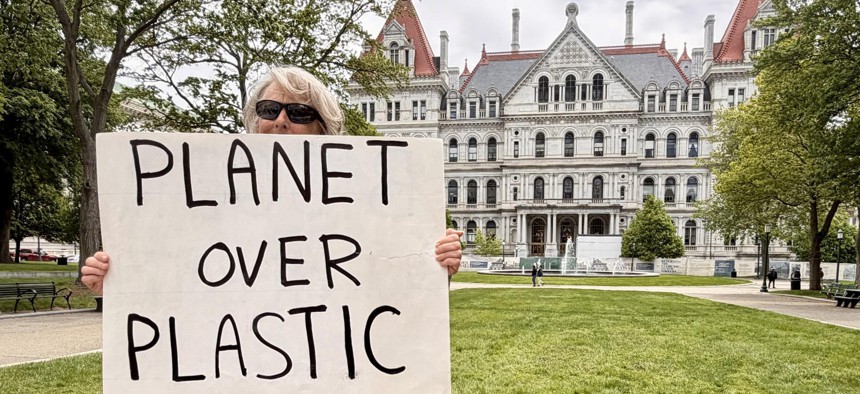
This climate advocate was one of dozens to rally in West Capitol Park on Monday in support of the bill to limit plastic packaging on products in the state. Kate Lisa



With the number of post-budget days to get any number of big-ticket items done before the end of the scheduled session waning, legislators and environmental advocates are once again pushing to pass the stalled packaging reduction bill. After the governor’s successful push to roll back New York’s climate law as part of the budget, legislators are especially keen to get marquee environmental bills like this one passed.
The bill’s sponsors, Assembly Member Deborah Glick and state Sen. Pete Harckham, recently introduced a series of amendments to the legislation in hopes of finally getting it over the finish line after years of near-misses. But powerful opposition forces in big business and the plastics industry still aren’t on board with the measure.
The Packaging Reduction and Recycling Infrastructure Act aims to reduce single-use packaging in the state by 30% over 12 years. The state Senate has passed PRRIA in past years, but the measure has stalled in the Assembly. It came close to passing in the lower chamber last year, but lawmakers ran out of time before Speaker Carl Heastie sent them home for the year.
Legislators feel strongly that this must be the year it passes in the Assembly. The rollbacks to the 2019 Climate Leadership and Community Protection Act loom large in the conversation this year as well. “After the drawn-out struggle over the climate law, the Legislature needs to pass positive climate bills this year,” Assembly Member Al Stirpe said in a statement to City & State. “The Packaging Reduction and Recycling Infrastructure Act is the perfect candidate. … We ran out of time to pass it last year and the year before, and we can’t let New Yorkers lose out again just because the governor dragged out the budget process as long as she could.”
PRRIA has been the subject of significant opposition lobbying, with state data showing the bill among the top 10 most lobbied measures in 2025. It was also one of only two non-budget bills to hold a spot in the top 10. Preliminary data for the first two months of this year showed PRRIA still held the No. 6 spot for top-lobbied bills as well. Groups including the New York State Business Council and the American Chemical Council (which represents the plastics industry) have spent big to combat the bill, and since last year, have pushed for their own alternative, closely modeled after so-called extended producer responsibility laws in other states.
Glick and Harckham have made a number of changes to the legislation over the years in hopes of combatting the well-funded opposition. (Even their 30% reduction is a concession – their original measure from years ago would have reduced packaging by 50% over 12 years.) Late in April, they made dozens of additional amendments meant to help get the bill passed. But speaking at a rally for PRRIA on Monday in Albany, Glick didn’t express optimism that business groups would come around. “Make no mistake, no matter how much we try to address the concerns of industry – which we have done at every turn – they simply do not want to change how they operate,” she said.
Indeed, opponents don’t see the most recent compromises as adequately addressing their concerns with the bill. “Multiple rounds of amendments have incorporated some ‘lessons learned’ from other states’ EPR efforts,” a memo released by the Business Council earlier this month read. “However, the bill remains imbalanced and will garner little business support.” Ken Pokalsky, the Business Council’s vice president of government affairs, told City & State late last month that while the coalition was given the opportunity to voice concerns to the sponsors, “there was never anything that looked like negotiations.”
The bill also faces continued opposition from certain segments of labor, including the United Steelworkers District 4 and the Teamsters. Both unions circulated memos to lawmakers this year arguing it would have negative impacts on its members in the paper industry and workers involved in solid waste recycling. “While the Teamsters share the common goal of packaging reduction with the sponsors, we cannot support legislation which could be so disruptive as to threaten the employment of our members who deliver beverages to millions of New Yorkers,” the Teamsters’ letter reads.
While business and plastics interests considered the changes minor, environmental activists considered them incredibly significant. Among the changes this time was the removal of a provision that would have created a new inspector general post to enforce the law, something advocates strongly wanted. “I don’t love these changes – they are major concessions to the plastics and petrochemical industry based on months of conversations with the sponsors,” Judith Enck, president of Beyond Plastics, told City & State late last month. “But the foundation of the bill is still solid. … So I think the sponsors operated in good faith.”
Assembly Member Anna Kelles also noted that major programs in place meant to address climate change existed before the CLCPA, and the state urgently needs to enact more environmental policy now so New York doesn’t further delay goals in the future. “Passing PRRIA, super important. One hundred percent, we cannot leave this session without it,” she told City & State. “It is not a replacement for (the CLCPA). We have to do PRRIA, plus.”