

Budget
Here’s what’s in the FY 27 New York state budget
Months late, packed with policy, an election-year special.
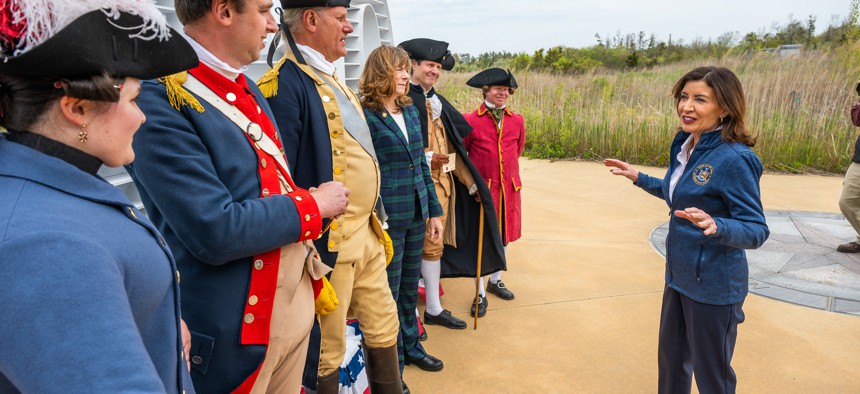
A budget so late it almost seemed it would miss the nation’s 250th birthday. Darren McGee/Office of Governor Kathy Hochul


It’s 57 days late, but New York finally has a budget for fiscal year 2027.
Lawmakers late Wednesday adopted the final measures of the state budget – the latest in 16 years – as Gov. Kathy Hochul signed the three budget bills they already passed into law.
The confusing, frustrating budget cycle has concluded nearly two months after the April 1 deadline, nearly three weeks after Hochul declared budget victory and nearly five pay periods since state lawmakers have received a paycheck. The final spending plan is $268.5 billion, according to the state Division of the Budget.
Legislators voted on six bills over the course of Wednesday – four spending bills that took effect as soon as they passed both chambers and two language bills that included policy such as a tax on expensive second homes in New York City. The Assembly wrapped up earlier in the evening, around 8 p.m., while the state Senate continued late into the night, passing the final bill just before 11:30 p.m.
Senate Majority Leader Andrea Stewart-Cousins took some responsibility for the late budget in remarks from the Senate chamber Thursday night. "Every budget has unique challenges,” she said, “and when those challenges involve major policy decisions, it's our responsibility to be both thorough and thoughtful throughout the process."
Though many aspects of the budget had previously leaked in bits and pieces, there were still changes even after matters were reportedly settled. The printed legislation sheds some light on the details of policy issues that Hochul and legislative leaders have debated for months in secret.
Until May 20, only one out of 10 bills – debt service – had received approval, and that’s only because late passage of that measure would mean New York defaults on its loans. Lawmakers voted to pass the Education, Labor and Family Assistance and Public Protection and General Government bills last week, both of which the governor signed on Wednesday.
Lawmakers jumped right in on May 26 coming off the long holiday weekend to debate and pass the Transportation, Economic Development measure – this year’s de facto “Big Ugly,” or omnibus legislation jam-packed with several of this cycle’s most controversial policy items. Hochul quickly signed that bill as well soon after legislators finished voting.
Now that it’s done, here’s what to know about what made it into the tardy spending plan. This post was last updated on May 27.
Immigration protections
The protections lawmakers approved May 21 go a little further than what the governor had originally proposed in her Local Cops, Local Crimes Act in January, but still fell short of the New York for All Act lawmakers wanted.
Banning local agreements
Under the approved language, local law enforcement will be prohibited from signing contracts with Immigration and Customs Enforcement known as 287(g) agreements and other contracts with federal immigration officials. Those agreements formalize the working relationship between localities and immigration officials, including information sharing, honoring detainer requests, use of local jails and even deputizing local police to enforce civil immigration law.
Notably, the language also prohibits informal agreements that are functionally the same as a 287(g) agreement, just without the contract. However, it doesn’t completely ban all informal collaboration, which is something the New York for All Act would do, and which lawmakers had pushed Hochul to include.
Suing ICE agents
The budget creates a mechanism for New Yorkers to sue ICE and other federal agents over constitutional rights violations, retroactive to January 2025. It additionally empowers the state attorney general to receive and investigate those complaints.
Sensitive locations
Lawmakers approved legislation in the spending plan that designates a large number of places around the state as “sensitive locations” that ICE cannot enter without a signed judicial warrant. Those include healthcare facilities, houses of worship, public and private schools, childcare facilities, parks, playgrounds and polling places. Additionally, state and local employees – excluding law enforcement – will be prohibited from collaborating with ICE for any civil immigration enforcement.
Education
Total school aid will again hit all-time highs, with the final budget including about $39 billion in education funding. That includes a guaranteed 2% increase to Foundation Aid to every school across the state for a total of over $27 billion. That amounts to a $200 million increase compared to last year’s budget, with $143 million of that increase going to New York City. The final spending plan also has some tweaks to the Foundation Aid formula to provide additional aid for English language learners, students in foster care and homeless children.
Universal pre-K
The budget also has an updated funding formula for statewide universal pre-K based on enrollment, full-day or half-day programs and other factors. All districts must provide full-day pre-K access to eligible 4-year-olds by the 2028–29 school year.
Electric bus mandate delayed
The state mandate for schools to only buy or lease electric school buses was pushed back five years to 2032. The deadline for districts to solely operate and maintain zero-emissions buses and vehicles was extended to 2040. The change was opposed by environmental advocates, but is expected to save school districts money.
Mayoral control
New York City Mayor Zohran Mamdani got a two-year extension of mayoral control of schools in the Big Apple. It was less than the four years he requested, but still he has come a long way from the campaign, when he suggested that he would not seek a renewal. Mamdani never proposed how to run public schools in the absence of mayoral control despite his critical take on the practice.
Public safety
One of Hochul’s budget priorities that received little pushback, and therefore was out of the spotlight early, was her proposals to crack down on the printing of 3D guns and glock switches. Once the budget is signed, it will be a class D felony for a person to manufacture a major component of a firearm, machine-gun, ghost gun, unfinished frame or receiver, firearm silencer or assault weapon or any component parts without a license. It also created safety standards for firearm prevention technology for 3D printers.
The public protection bill passed Thursday also establishes a crime for the unlawful use of a drone and creates “the New York state blue list,” which requires state agencies to only buy drones and related equipment from vendors on its own registry.
Buffer zones
After months of push and pull, Hochul’s proposal to establish demonstration buffer zones around religious places of worship was included in the final budget. It’s now a crime – a class B misdemeanor – to intentionally interfere with a person attempting to access, or enter or exit, a place of worship. And it creates a 50-foot buffer for demonstrations that create “reasonable fear” for parishioners’ safety, and allows police to create a 50-foot security perimeter to protect worshippers at any time.
The governor initially proposed a 25-foot buffer zone around houses of worship and reproductive health centers, but the latter fell out of the long-debated compromise after concerns it would violate the First Amendment. This comes on the heels of Mamdani’s decision to veto a controversial New York City Council bill requiring police to make and publicize plans for security perimeters around educational facilities during protests; the council did not override the veto, but are planning to introduce new, even more watered down legislation to that effect.
Auto insurance
The general government bill included some, though not all, of the car insurance reforms Hochul wanted that emerged as key sticking points in the prolonged budget debate. Lawmakers approved some of the less thorny aspects of the broader changes on Thursday, including a provision to prevent insurance “red-lining” that Hochul had not originally included. The budget will prohibit insurers from using consumer data like zip code, education level and homeownership to set individual premiums. The approved bill also will end a provision that has allowed insurers to unilaterally raise rates by up to 5% – which was another measure added by legislators.
On the measures that Hochul had pushed for, the budget redefines the meaning of “serious injury” to make it more restrictive in an effort to reduce payouts to accident victims. It also changes the law so that anyone found to be more than 50% responsible for a crash won’t receive any compensation. And it caps payouts for pain and suffering at $100,000 for the driver if they are committing a crime at the time of the accident, including drunk driving and driving without insurance.
The budget additionally enacts new measures meant to combat insurance fraud and crack down on staged accidents that Hochul has said contributes to high insurance rates.
NYC zombie charter revision commissions
Mamdani asked the Legislature for a solution to address the city charter revision commission formed by his predecessor, Eric Adams, and legislative leaders delivered.
The budget includes a provision to allow mayors to nullify commissions convened by a previous administration after they leave office. It was a late addition in spending plan negotiations, with state lawmakers learning about the plan for the first time earlier this week, or seven weeks after the April 1 deadline.
Housing
J-51 renewal
The less-sexy cousin to 421-a/485-x, the J-51 tax abatement for building and apartment improvements or preservation in New York City received a 10-year renewal in the budget to extend it beyond its expiration date this year. Currently, eligible projects must be completed by June 30, but the budget extends that to 2036. It incentivizes building owners to make necessary improvements – including those to adhere to the city’s climate law – while ensuring at least some affordable housing is included.
The final spending plan largely adopted Hochul’s initial proposal for extending the program, and includes an option for a 10-year tax abatement period instead of the usual four-year period. Eligible buildings must be at least 50% affordable, similar to the previous version of the program, as negotiations ultimately did not pan out for a legislative proposal for higher levels of rent stabilized units.
State Environmental Quality Review Act
Most lawmakers were already on board with Hochul’s push to modernize the state’s burdensome environmental review process enacted in 1976. The final budget completely exempts certain types of projects from the process in efforts to hasten construction of affordable housing. Changes to the State Environmental Quality Review Act stayed largely consistent since Hochul’s “handshake agreement” she announced nearly three weeks ago. Childcare centers are no longer exempt from the lengthy review process, largely because childcare facilities do not have their own zoning category.
The budget exempts housing projects with up to 250 units in New York City, and up to 500 units in medium- and high-density areas in the city, up to 300 units in urban areas outside the five boroughs and up to 100 units in nonurban areas from the review process. Projects are capped at 20 units in municipalities without zoning. Housing must be on previously disturbed land and connected upon occupancy to existing water and sewer systems.
Other projects are also exempt from SEQRA, including public parks and trails projects, green infrastructure, clean water infrastructure that avoids negative impacts to natural resources and public school buildings in New York City built by the School Construction Authority. The city school buildings provision was added after the child care facilities were removed, according to the governor’s office.
Some lawmakers expressed concern with the changes during floor debate, specifically the fact that there’s no opt-out provision for municipalities.
Climate
Climate Leadership and Community Protection Act rollbacks
The governor won some significant changes to the 2019 Climate Leadership and Community Protection Act, one of a handful of high-profile issues that held up the budget for nearly two months. The budget will delay the deadline to implement required regulations to hit various climate goals to the end of 2028, almost a full three years after the initial 2024 deadline Hochul’s administration blew past. The change will make an ongoing lawsuit over the need to enact regulations moot.
The new language also explicitly mentions cap-and-invest for the first time in the climate law statute, though it doesn’t actually mandate the program.The budget doesn’t eliminate the current 2030 target of a 40% emissions reduction compared to 1990 levels, but the new language effectively circumnavigates that benchmark in favor of a new one in 2040. That target is slightly softer, mandating a 60% emissions reduction below 1990 levels “to the maximum extent feasible.” But it kept the binding 2050 target of an 85% reduction in place.
The budget also amends the accounting methods the state uses to measure greenhouse gas emissions. The original CLCPA used a 20-year timeframe to measure the so-called “global warming potential” of greenhouse gases, a newer, but still less common, method that scientists have said more accurately accounts for gases like methane that have huge impacts without remaining in the atmosphere for long. The budget moves New York to a 100-year timeframe – less precise but far more common accounting method that will improve the appearance of the state’s progress in reducing emissions without any additional action.
Accelerate Solar for Affordable Power Act
The budget includes a version of the Accelerate Solar for Affordable Power Act, a measure meant to – as the name indicates – help rapidly deploy distributed solar and increase grid interconnectedness. That includes solar panels on homes that reduce grid strain while feeding power back into the grid as well, rather than utility-scale solar farms.
However, the budget version lacks one of the key aspects of the legislative proposal that has already passed in the state Senate this year: new statutory mandates for distributed solar power, one of the areas of the climate law New York is actually ahead of schedule on. Absent from the budget language is a new 2035 goal of 20 GW of distributed solar to spur state authorities to better incentivize the installment of solar panels, as well as certain language mandating action from the Public Service Commission. New York has already met its 2030 goal of 10.5 GW.
Sustainable Future Program
As it did last year, the budget includes $1 billion for the Sustainable Future Program. The fund is meant to advance climate mitigation measures and support green job development in order to help the state meet its climate goals. Hochul initially did not include new funding for the program this year, but she threw her support behind the new investment after she pitched changes to the state’s climate law.
Pied-à-terre tax
The details of a New York City tax to impose a surcharge on luxury second-homes with an assessed market value equal to $5 million or more, or a residential condominium with a market value of $1 million or more. That assessed market value is determined by existing New York City Department of Financial Services metrics – metrics generally criticized for undervaluing many homes that go on the market for far more than they are assessed.
Owners of one- to three-family second homes with an assessed market value between $5 million and $15 million would pay a 0.8% surcharge. Properties assessed from $15 million to $25 million would have a 1.05% surcharge imposed. And those assessed at $25 million or above would have a 1.3% surcharge to pay.
The budget introduces a two-year "transition period” for the city to implement a more accurate way to assess the value of condos and co-ops. Currently, they are valued using an estimation of their potential rental value, which leaves many severely undervalued compared to what they are actually sold for. During that period, condos and co-ops with assessed values of $1 million to $3 million would have a 4% surcharge. Those worth between $3 million and $5 million under the current system would have a surcharge of 5.25%. And properties assessed at $5 million or above would have a 6.5% surcharge. These rates and valuation levels would change after the two-year transition period around whatever new, more accurate assessment method the city adopts to more closely reflect actual listing prices.
The updated assessment measure would also apply to one- to three-family homes, but the current valuation and surcharge rates will remain the same.
Under budget language, the tax on ritzy second homes will sunset after five years.
Alternative nicotine pouch tax
New Yorkers who use smoke-free nicotine pouch products will soon see their costs soar. Alternative nicotine pouches like Zyn will now be taxed like all other tobacco products with a 75% excise tax, which will generate about $54 million a year for Medicaid and health services. It was the sole revenue raiser that Hochul included in her initial budget proposal, arguing it would benefit public health and discourage use of the products. Pushback from business groups and faith leaders over fears the tax would fuel the illicit market proved unsuccessful.
No tax on tips
Hochul first posed eliminating income taxes on tipped wages in January – adopting the change that was a popular campaign item for Republicans and President Donald Trump. Its inclusion in the final budget isn’t a surprise since it received little, if any, opposition in a budget focused on making the state more affordable. But the elimination of that tax effectively cancels out the new alternative nicotine product tax, and will cost the state about $50 million annually.
Public pension reform
Tier VI changes
Public sector unions got some big wins statewide thanks to a late – but powerful – push to amend New York’s most recent retirement tier for public workers as public employers have struggled to recruit and retain high-quality workers. Lawmakers didn’t go as far as what labor initially proposed, which the state estimated would have cost $1.5 billion, but unions still walked away with some major victories with a much lower $577 million price tag.
Under the budget changes, all state and public workers will be asked to contribute less of their salary to their retirement, ranging from 3% to 5.75% depending on income. That’s only slightly lower than the current 3% to 6%, but lower-income workers see the most benefit in the contribution rate reductions.
Separately, teachers around the state will be allowed to retire at 58 after 30 years of service, rather than at 63. Though labor unions had asked for a retirement age of 55 for all Tier VI workers, reducing the age for teachers was the compromise. The budget also increases the amount of overtime eligible for inclusion in calculating retirement benefits from 15% to 25% of wages for state police and firefighters. The overtime cap for all other public employees went from $22,000 to $30,000, which is expected to benefit corrections officers.
New York City pension amortization
At the behest of Mamdani, the final budget gives the city the authority to push off some pension payments required over the next five years in order to help balance this year’s budget. Facing an over $5.4 billion budget hole his first year in office, the state action will save Mamdani over $2 billion – though the move will still cost the city billions down the road.
Correction officer ‘death gamble’
The final budget includes another win for the state correction officers’ union that will allow the beneficiaries of officers who die in the line while working after retirement age to collect a sum of their pension benefits. The pension tweak will cost the state a one-time $25.6 million and $1.7 million per year thereafter.
Super speeders
The budget permits New York City to enact a pilot program meant to crack down on so-called “super speeders” – chronically fast drivers who have racked up lots of speeding tickets. Under the proposal, drivers who have received 16 or more speed camera tickets over a 12-month period will have a speed-limiting device installed in their car at their own expense.
Utility relief
The budget includes a series of measures meant to help New Yorkers struggling with high utility costs. One provision will create a “blue ribbon commission” to look into raising utility costs and make recommendations on energy savings. The commission would have appointments from the governor and Democratic legislative leaders, but wouldn’t include any input from the Republican minority.
Additionally, the budget language places new reporting requirements for utility companies seeking rate increases, such as the salaries for top executives and average income of company workers. It would also require companies to submit a second, “budget constrained” proposal if seeking rate hikes. And if the Public Service Commission approves a hike of 3% or higher for gas or electric service, it would have the power to install an “independent affordability monitor” for a year within the utility company.
There’s also a new requirement that should a company have excess profit, it must refund it to customers in the form of bill credits rather than keeping it, as they currently do.
Protecting Our Wallets Energy Rebate checks
The budget also includes direct utility relief in the form of $1 billion worth of rebate checks that will be sent to 8.2 million New Yorkers. The checks range from $100 to $200. Single filers with incomes below $150,000 will get a $100 check. Joint filers who make under between $150,000 and $300,000 will receive a $150 check. And joint filers who make under $150,000 will get the highest payment of $200. The state sent out similar “inflation refund checks” last fall. This one is sure to hit mailboxes before Hochul is on the ballot in November.
Healthcare
MCO Tax
A higher state tax on Medicaid insurers that was set to expire will become permanent starting Jan. 1, 2027. Earlier this year, the federal government extended an existing higher tax on managed care organizations for nine more months.The tax on managed care organizations, initially included in the budget three years ago, has generated over $3 billion for the state to date to offset ballooning Medicaid costs. It was originally created before the U.S. Center for Medicare & Medicaid services changed its policy, closing the loophole that several states, including New Jersey and California, have cashed in on. State budget officials said the tax was tweaked in the latest spending plan, and will tax Medicaid insurers 0.35% of a health plan's total premium revenue each year. The new uniform tax will be subject to federal approval, according to the governor’s office, but the timeline for that process is unclear. The budget also includes guidelines for how the state will invest existing funds from the tax.
Local aid
Support for distressed cities
The budget allocates $135 million specifically for six distressed and financially struggling cities across the state. Yonkers is set to receive the most at $40 million, with Buffalo next at $25 million. Albany, Rochester and Syracuse each will get $20 million a piece, with the final $10 million headed to Mount Vernon.
The money is on top of the additional $150 million in Temporary Municipal Assistance provided for in the budget by the governor. Of that, $30 million was earmarked specifically for Buffalo, and $20 million for Albany.
Medicaid
The final budget includes $1.5 billion in new Medicaid funding for various healthcare facilities. Hospitals will get the lion’s share of the increase with $706 million in new money. Nursing homes will get $480 million, while federally qualified health centers will receive an increase of $80 million and assisted living centers getting a $20 million bump. Notably absent, however, is any specific relief for the roughly 450,000 New Yorkers set to lose coverage under the Essential Plan at the start of July.
Correction: This story has been updated to reflect that the budget was 57 days late, and that Hochul’s handshake agreement on May 7 did not include an exemption from the state environmental review process for childcare centers.
NEXT STORY: 5 things to know about Mamdani’s big housing plan