

News & Politics
Julie Su: deputy mayor for economic justice – and damage control
A self-described “new New Yorker,” Mamdani’s partner in job creation and worker protection is setting up meetings with the oligarchs, and they’re going well!
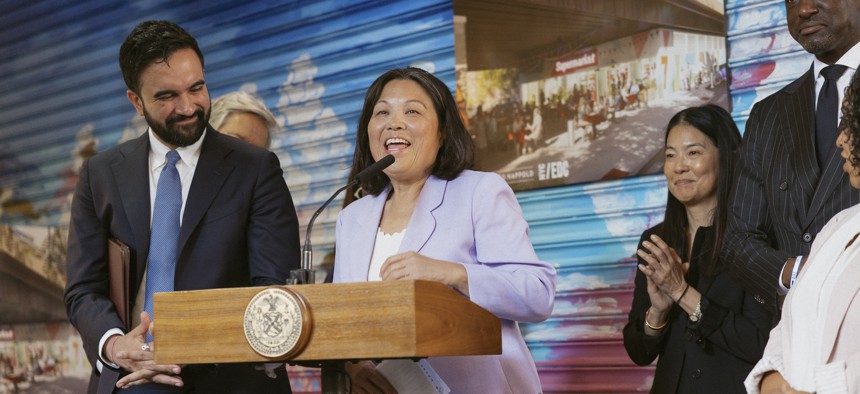
Deputy Mayor for Economic Justice Julie Su has garnered praise from CEOs. Kara McCurdy | Mayoral Photography Office



On April 15, Mayor Zohran Mamdani published a video of himself standing outside a hedge fund CEO’s $238 million second home to tout a new pied-à-terre tax, angering the city’s business elite who thought the stunt was counterproductive at best, hostile at worst.
But the next day, Mamdani’s Deputy Mayor for Economic Justice Julie Su met with the president of the Real Estate Board of New York, Jim Whelan. "She was a very impressive person, very impressive background,” Whelan told City & State. “She's very engaging and personable."
As Ken Griffin, whose pied-à-terre Mamdani made famous, threatens to scale down his company Citadel’s operations in New York City and “double down on our bet in Miami,” and as Florida Gov. Ron DeSantis claims Mamdani’s the “realtor of the year” for pushing businesses out of New York, Su has been shaking hands with the very business titans everyone’s worried are getting spooked.
The week after the Griffin video, Su and the mayor met with the leaders of the big business interest group the Partnership for New York City, Steve Fulop and Rob Speyer. Su also sat down with the CEO of JetBlue Airlines, Joanna Geraghty, with billionaire businessperson and political megadonor John Catsimatidis and with RXR Realty CEO Scott Rechler. She joined the mayor for meetings last month with Chobani CEO Hamdi Ulukaya and Bank of America CEO Brian Moynihan. On Wednesday, Su and the mayor met with billionaire Democratic donor and president of Blackstone Jonathan Gray. More executive meetings are in the works. And despite the narrative that the administration doesn’t engage with big business, the meetings – according to conversations with Su, the mayor’s office and several of the participants – are going well.
“Of course, we brought up the Ken Griffin stuff and the video, but like, the topic of the conversation was really about, how do we have a constructive relationship to create jobs and build the local economy?” Fulop said, adding that he’s met with the mayor several times. In a statement, Rechler said the meeting with Su about his supertall project at 175 Park Avenue was “collaborative and productive.” Catsimatidis’ spokesperson said the grocery store magnate was there to “offer his services as an expert in the food business at 0 cost to the city.”
“A lot of times the CEOs recognize that (New York City) has been a good place to do business for them. They're here because they've made a lot of money,” Su told City & State of the meetings. “So I think being able to push beyond that to, OK, so what can we do to make it work for more people and make it more just, is – I appreciate those conversations.”
Su is the first to hold the title deputy mayor of economic justice – a pointed inversion of the typical name for the role that focuses on economic development. Prior administrations have selected someone from New York City’s business community for the role. Mayor Mike Bloomberg hired banking executives Robert Steel and Dan Doctoroff to be his deputy mayors for economic development and rebuilding. Even lefty mayor Mayor Bill de Blasio hired Goldman Sachs investor Alicia Glen to be his deputy mayor for housing and economic development. Mayor Eric Adams’ pick, Maria Torres-Springer, was not herself a business person, but she had a long career in New York City economic development circles, previously working for Glen and for the city’s Economic Development Corp. Su, by contrast, comes from the worker protection world. She was previously the labor commissioner and then secretary of labor in California before going on to serve as acting U.S. secretary of labor in the Biden Administration. She moved to New York City for the City Hall job, where much of her focus has been on Department of Consumer and Worker Protection wins, such as cracking down on fair work week violations and delivery apps.
The choice of Su – and her title – were interpreted much in the same way as the Griffin video: sending the message that this administration is putting the owners of the means of production on notice, and prioritizing the workers.
But the Mamdani administration isn’t so ideological that they’re ignoring positive outcomes for the capitalists. They’re just touting them in a more subdued way. Ahead of a sitdown interview with Su, her office shared a list of positive economic indicators for the city including all-time high numbers of finance and insurance jobs in the city, a whopping $11.1 billion in venture capital funding for New York City companies in the first quarter of 2026 and all-time high Wall Street bonuses last year ($49.2 billion). “We want businesses who have chosen to be in New York City to hear from us that we're really committed to having them stay here and committed to building the infrastructure that helps them to succeed here,” Su said.
The city is on relatively firm financial footing. Though he had a small dust-up earlier this year with bond rating agencies that cast doubt on his plans, the mayor just presented a balanced executive budget that doesn’t dip into reserves or raise property taxes, as he threatened to do. There were some concerns about job loss, but a reevaluation of jobs data shows the city actually added jobs last year. Demand for Manhattan office space is also rising.
Still, the message is not always getting across. More than four months in, Mamdani has still not named a CEO for the New York City Economic Development Corporation. After American Express announced it would build a new 55-story headquarters at the World Trade Center complex, Gov. Kathy Hochul cheered in a press release: “Thank you to American Express for doubling down on your commitment to New York.” Mamdani didn’t express gratitude or mention the company, instead calling the deal “a testament to the power of union labor and the dignity of work” – a tonal difference not lost on Whelan, of REBNY. “There seems to be an indifference on the part of this administration to business recruitment and job retention,” he said.
And then there is the rhetoric about taxes. Mamdani has repeatedly called for higher taxes on wealthy individuals and on corporations. Though he hasn’t succeeded in securing those tax increases, the city’s business leaders are complaining of feeling attacked. “Moving forward, Mayor Mamdani does seem to have somewhat of an insatiable appetite for new taxes,” Whelan said, adding that there will be more funding pressures to come. “Next year, the state has a much more difficult fiscal situation than it does this year because the spending cuts in the One Big Beautiful Bill take effect."
And the rhetoric around New York City’s hostility to business continues, even as the administration welcomes business leaders into City Hall. The Partnership for New York City has already raised millions to fight Mamdani’s tax agenda. Asked whether we’re seeing a coordinated escalation in rhetoric from CEOs, Fulop demurred. “The business community is being, yes, effective, because there is sincere concern around the competitiveness of New York City, and there is a sense of urgency that you want to see policies that put us on more firm footing relative to other cities that are pursuing our jobs,” Fulop said.
This story was updated after publication to clarify that both Su and the mayor met with the Partnership for New York City, and that they’ve met with the Partnership multiple times.
NEXT STORY: DSA Assembly candidate changes his defense of Bondi internship