

Education
NYC schools chancellor: Class size mandate will be ‘very difficult’
Kamar Samuels faced his first grilling before the City Council in a preliminary budget hearing.
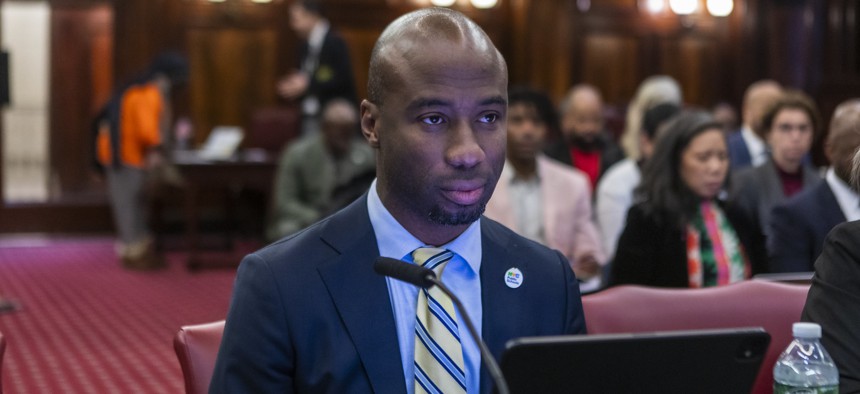
It was oral exam time for New York City Schools Chancellor Kamar Samuels Emil Cohen/NYC Council Media Unit


New York City must reduce school class sizes under a state mandate by the fall, but Schools Chancellor Kamar Samuels acknowledged the massive challenge of that undertaking at a City Council hearing on Monday.
“I think it’s going to be very difficult to get to 80% by September,” Samuels said, referencing the mandate for 80% of classrooms to have 25 students or fewer (depending on the grade level) by the 2026-2027 school year. In the current school year, compliance is at 64%, City Council Education Committee Chair Eric Dinowitz said.
Samuels’ remarks came at a marathon preliminary budget hearing, in which Dinowitz and a rotating cast of council members questioned education department officials for nearly five hours. Samuels, a former superintendent, took over the role of chancellor in January with the start of Mayor Zohran Mamdani’s new administration.
The remarks also come as a champion of the class size law, state Sen. John Liu, has recently signaled some openness to granting additional time and resources to comply with the mandate as long as the administration has a plan in place for implementation. The budget watchdog group Citizens Budget Commission also called for relief in the mandate in prepared testimony on Monday, particularly in light of the city’s current budget challenges.
The challenge of meeting the class size requirements comes in both finding additional physical space for new classrooms and hiring additional teachers. “We are committed to ensuring that we are moving towards this law as aggressively as possible,” Samuels said Monday.
Mamdani’s preliminary budget proposal includes nearly $543 million in fiscal year 2027 to support the mandate, with that funding set to grow to nearly $943 million in fiscal year 2028. The Department of Education budget represents a whopping 29% of the city’s total expense budget with $38 billion allocated in the preliminary budget.
In light of declining enrollment, Samuels said the department is focusing on finding space within its current buildings for new classroom space. “We are closely collaborating with the School Construction Authority, unions and elected officials to analyze our physical footprint, brainstorming capital and operational strategies to meet the mandate,” he said. As part of that work, the department has sent a survey to all principals asking what they will need to comply.
But some council members raised concerns about how the department will go about finding new space within its current buildings and urged that it not come at the expense of spaces like art and theater rooms.
City Council Member Lincoln Restler said that while he wants the city to reduce class sizes, he also wants to protect those spaces. “There’s a tension here that I’m very concerned about, and I’m not really hearing how we’re solving for it.”
Lowering class sizes is far from the only challenge on Samuels’ plate. As schools grapple with how students and teachers should use artificial intelligence, Samuels announced that the department will release its “foundational AI guidance” on Tuesday.