

Budget
Mamdani’s counting on pension restructuring to balance the budget. Will the unions let that happen?
The city’s five municipal pension funds are partly controlled by union representatives who aren’t jumping for joy at the idea of delaying payments.
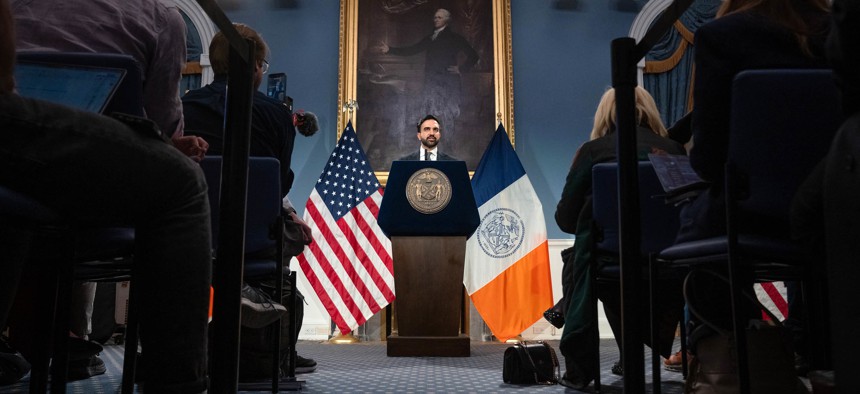
Mayor Zohran Mamdani is counting on pension restructuring. Ed Reed/Mayoral Photography Office



Mayor Zohran Mamdani wants to delay certain payments to the city’s pension funds to help close the city’s multibillion dollar funding deficit. The only problem is that he needs municipal labor unions’ approval to change up their retirement accounts, and some unions are mum about the plan while others outright oppose it.
While it’s still early, the unions’ apprehension to immediately get on board speaks to the plan’s politically sensitive nature. The pension restructuring proposal is one of the lifelines Gov. Kathy Hochul is offering the city, giving state approval for the city to stretch out its annual public pension contributions so that it meets its long-term obligation by 2037 instead of the current 2032 deadline. There are five municipal pension funds, which add up to about $300 billion, representing teachers, education workers, police, firefighters and other unionized city employees. Stretching out payments would save the city an estimated $2.3 billion over two years, according to the Mamdani administration’s budget plan released Tuesday. Precise language from the state is still under review, but is expected to be included in the state budget deal.
Mamdani said that the proposal would have “no impact on retirees and their benefits or current employees and their future benefits.” Critics, like the fiscal watchdog group Citizens Budget Commission, have raised concerns that it pushes costs into future years, creating a burden for future New Yorkers in the name of short-term relief.
Like any other proposed change to the city’s municipal pension funds, union approval will be key. Each of the five funds is overseen by a board of trustees composed of union representatives, elected officials and appointees that must approve any proposed changes. To achieve what the city is projecting in savings, Mamdani is banking on four of the boards to opt into the proposal: the New York City Employees’ Retirement System, the Teachers’ Retirement System of the City of New York, the New York City Fire Pension Fund and the New York City Board of Education Retirement System. None of the main unions have committed their support yet.
The New York City Police Pension Fund is unlikely to end up being impacted. John Nuthall, a spokesperson for the Police Benevolent Association, said that neither the union nor the board of trustees has agreed to the restructuring plan.
Detectives’ Endowment Association President Scott Munro, who sits on the board, took a more definitively critical stance. “NYC Detectives put their lives on the line every single day to keep this city safe. Our pensions belong to us – not to the city – and we are not a piggy bank for elected officials looking to clean up the mess created by failed leadership and reckless spending,” he said in a statement. “We will fight to protect our rights, and we will remember every public official who stands against us.”
Spokespeople for District Council 37, the city’s largest municipal union, and the United Federation of Teachers said they are still looking over the mayor’s proposal.
"The city has asked for pension restructuring,” UFT President Michael Mulgrew said in a statement. “Any plan needs state approval and has to be evaluated and approved by the trustees of the pension boards to be enacted.”
The Uniformed Firefighters Association did not respond to a request for comment.
Mayoral spokesperson Dora Pekec declined to say which pension funds the Mamdani administration expects to be subject to the plan. “The estimation is based on four and we’re confident in that estimation,” she said, adding “the administration is in conversation with all unions, including PBA.”
Labor representatives are expected to vote in the interest of their union based on what they view to be in the best interest of the pension fund’s long-term health. It’s a sensitive topic. A lot of eyes will be on the decision – the city’s unionized work force banks on strong retirement packages.
The city’s pension obligations have been a challenge for years. Former Mayor Michael Bloomberg and Gov. Andrew Cuomo reformed the city’s pension payment system in 2012 after the assumed rate of return dropped to 7% from 8%. That drop meant the city needed to pay more money up front, creating a seismic multibillion dollar unfundated mandate. Bloomberg and Cuomo agreed to stretch out payments through 2032 with the expectation that the obligation would be paid off by then. More than a decade later, the city’s current obligation amounts to nearly $39 billion, with annual costs exceeding $10 billion. Mamdani’s proposal would stretch out payments another five years, setting the deadline for 2037 instead. This would free up savings the city would then use toward plugging its multibillion budget deficit.
Some, like the fiscally conservative Citizens Budget Commission, are leery. “We are already paying in 2026 and 2027 for benefits earned almost two decades ago,” said Ana Champeny, Citizens Budget Commission vice president for research. “To further stretch this out, is asking future New Yorkers, it’s asking taxpayers in fiscal year 2033, 34 to balance today’s budget.”
A failed pension restructuring proposal from then-Mayor Eric Adams backed by Gov. Kathy Hochul last year ultimately ran into steep opposition from unions. Adams had wanted to delay payments through 2044, which he’d projected would generate about $1.3 billion in savings in its first year. The UFT had been particularly vocal in its opposition, though this had largely hinged from a lack of trust in Adams, who’d been under indictment at the time, according to a source familiar with the situation. Mamdani has no such baggage.
The breakdown of each of the boards of trustees overseeing the pension funds vary. Three of the seven board members overseeing the Teachers Retirement System are members of the UFT. There are also two mayoral appointees, Comptroller Mark Levine and the chair of the Panel for Educational Policy. While union representatives don’t technically hold the majority, Mamdani’s proposed pension restructuring would need all three labor votes to pass, according to a UFT spokesperson.
The PBA holds four of the seats on the Police Pension Fund board of trustees – half of all of the union representation, which would be the only members voting on pension restructuring. Elected officials compose the majority of the Employees’ Retirement System board of trustees. Levine, Public Advocate Jumaane Williams and each of the five borough presidents are all members, as is District Council 37 Executive Director Henry Garrido and the presidents of Transport Workers Union and the International Brotherhood of Teamsters.